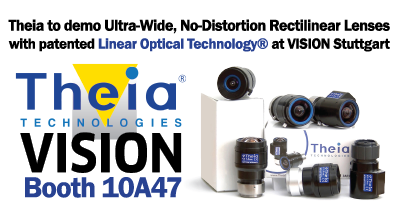
Wide-angle lenses typically introduce barrel distortion that must be corrected digitally, adding power, compute, and processing costs downstream — and even then, digital de-warping can’t recover the resolution already lost at the edges of the frame. Most vision systems handle this the same way: let the optics distort the image past 90° horizontal field of view (HFOV), then fix it in software, or, mount several narrower-angle lenses and stitch their images together, multiplying cost, complexity, and processing overhead. Theia will demonstrate its solution to this problem at VISION Stuttgart, Booth 10A47.
Theia’s patented Linear Optical Technology® corrects barrel distortion optically, at the design level, with no digital de-warping required. This rectilinear lens design maps the scene to the sensor in a way that holds resolution constant across the frame, rather than compressing it toward the edges as a standard fisheye-style projection does — keeping straight lines straight up to 135° HFOV. Visitors can see the result firsthand: a clean, undistorted image delivered straight out of the lens, before it ever reaches the vision system’s processing pipeline.
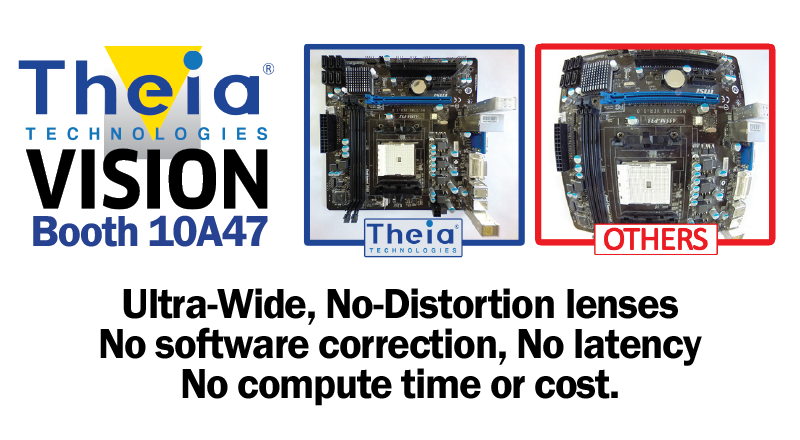
Because distortion is corrected in the optics rather than in software, there’s no dewarping-induced latency either — making these lenses well suited to real-time situational awareness in unmanned vehicles, drones, and robotics for observation, inspection, surveillance, and pick & place. The payoff shows up exactly where wide-angle systems tend to fail: object detail at the periphery of the frame stays sharp enough to raise the probability of detecting and identifying defects and objects at the image edge.
Visitors will also learn about an application case study where an automated wire-crimp inspection system built around a 5MP Sony IMX335 sensor removed a full-frame resampling step — processing ~5M pixels at 30fps — even though inference only needed a 256×256 region of interest, about 1.3% of the image. That reduction in redundant computation cut memory bandwidth and processing load enough to sustain real-time inference at just ~0.89W, letting the system run on an STM32N6 microcontroller instead of a 240W processor — freeing up compute and power for edge image processing, machine learning, and other AI tasks; as well as saving ~90-95% startup hardware costs and 99% operational energy costs.
Visit Theia at VISION booth 10A47. Set up a meeting beforehand or request a sample at